Move beyond the old “gift watch” article
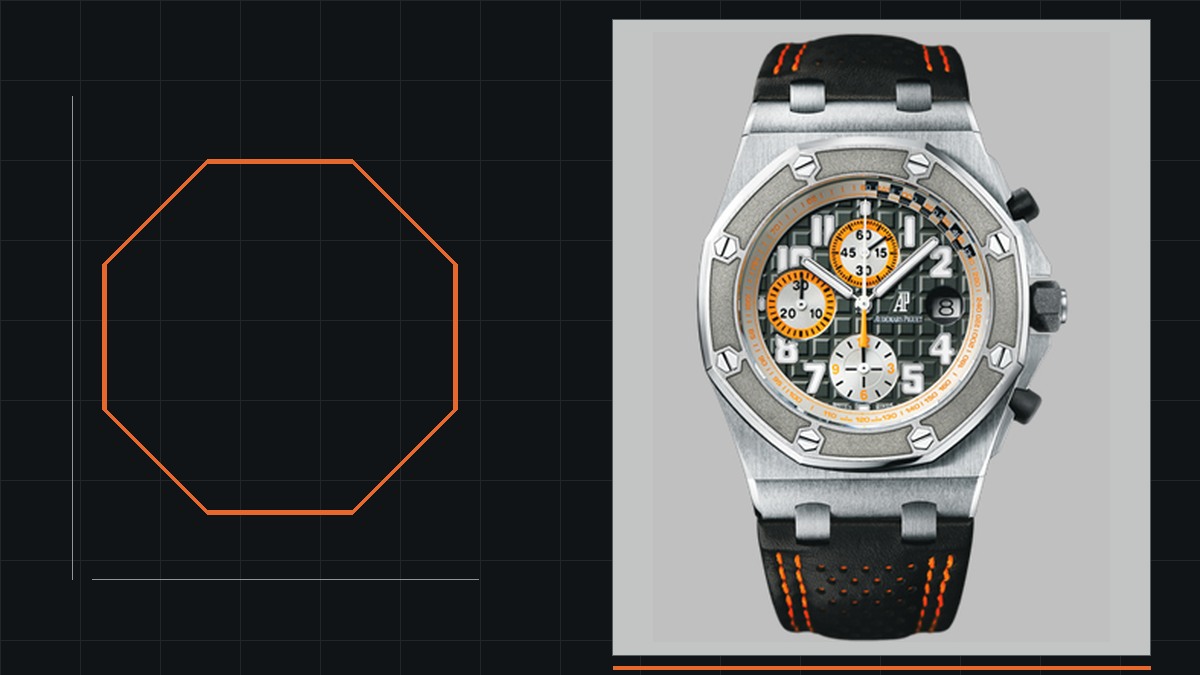
The old version of this page read like a story about shopping for a husband and quoted prices from a different market era. The useful subject is the watch itself. Today the Royal Oak Selfwinding Chronograph 26240 gives a clear modern reference point: 41 mm in diameter, 12.4 mm thick, 50 m water resistance on the genuine steel model, a Grande Tapisserie dial and integrated Calibre 4401.
That architecture matters to a replica because the chronograph movement determines subdial positions, date placement, pusher feel and case thickness. A generic chronograph squeezed into a Royal Oak-shaped case may look close in one photograph but usually shifts one or more of those relationships.
Subdial spacing is a movement fingerprint
Measure visually from the center pinion to each subdial. On poor copies, the counters sit too close to the center or too far toward the edge because the underlying movement was not designed around the same architecture. The date aperture may then be moved or resized to compensate.
Check the small-seconds counter and totalizers for equal printing quality. The hands should sit level, reset to their zero marks and remain clear of neighboring indices. A watch that photographs well while stopped can reveal problems immediately when the chronograph is started and reset.
The case has to carry the complication without looking bloated
At 12.4 mm, the genuine 26240 is not ultra-thin, but the case still maintains disciplined horizontal layers. Inspect the bezel, mid-case and caseback from the side. A replica that is several millimeters too thick changes the entire visual balance, especially where the bracelet meets the case.
The chronograph pushers should sit parallel and integrate cleanly with the case. Look for rough machining around the pusher tubes, crowns that protrude too far and brushing that changes direction unexpectedly around the shoulders.
Calibre 4401 changed the modern benchmark
Calibre 4401 is AP’s integrated selfwinding flyback chronograph operating at 28,800 vph with about 70 hours of power reserve. It uses 381 parts and places the flyback function within the movement rather than relying on a module added above a time-only calibre. A replica seller may use the phrase “4401 clone,” but the claim should be broken into visible and functional evidence.
Ask whether the chronograph is truly mechanical, whether all counters work, whether the flyback function exists if claimed, and whether the date changes normally. A decorated caseback that resembles AP finishing is secondary to those functional questions.
QC the chronograph under motion
- Photograph the dial with the chronograph stopped.
- Start it and confirm the central chronograph hand moves as expected.
- Stop and restart to check pusher consistency.
- Reset and verify every timing hand returns precisely to zero.
- Check the date at several positions and confirm the aperture remains centered.
- Inspect case thickness and bracelet fit from both sides.
Chronograph hand clearance is an underrated QC point
A multi-level chronograph dial places several hands over recessed or raised counters. If the hand stack is incorrect, hands can touch one another, brush the dial or sit visibly too high above the surface. Ask for a short video with the chronograph running while the watch is tilted. This can reveal wobble, contact or uneven hand heights that still photographs hide.
Reset behavior distinguishes adjustment from real quality
Many chronograph hands can be manually aligned at assembly, so a photograph showing perfect zero position does not prove the mechanism resets accurately. Run the chronograph for at least a minute, stop it, then reset several times. A hand that repeatedly returns slightly left or right of zero points to adjustment or movement issues rather than dial printing.
Caseback depth often exposes a movement substitution
When a movement is thicker than the intended architecture, the easiest place to hide the extra height is the caseback. Compare the side profile at six and twelve o’clock, not only around the crown. A deep back can alter how the watch sits on the wrist even when the bezel and mid-case look reasonably close.
Pushers should feel like part of the case, not add-ons
Chronograph pushers are functional hardware and visual markers. Unequal spacing from the crown, loose tubes or buttons that sit at different depths are easy to miss in front views. Ask for a crown-side macro image and confirm both pushers return to the same resting position after use.
Date change timing can reveal movement shortcuts
Different movements begin and complete the date change at different times. A replica does not have to mirror the exact AP transition, but an unstable or partially engaged date near midnight can indicate poor movement adjustment. Check that the date completes cleanly and that the crown has distinct setting positions.
Decision note: chronograph reliability is worth more than cosmetic complexity
A chronograph replica with every bridge decorated to resemble AP but inconsistent reset behavior can be frustrating to own. If choosing between two versions, prioritize stable operation, correct counter spacing and serviceability before display-back decoration. The chronograph is a mechanical function that will be used repeatedly; cosmetic similarity is only one layer of quality.
Source notes
Technical specifications in this file are cross-checked against manufacturer material where available.