Start with the architecture
Audemars Piguet watches are unusually unforgiving subjects for reproduction. The Royal Oak was built around visible construction: an octagonal bezel, eight exposed hexagonal screw heads, alternating brushed and polished planes, a patterned dial and an integrated bracelet that becomes part of the case. A copy can look convincing in a small catalogue photograph and still fall apart under closer inspection because one of those relationships is wrong.
The original homepage focused heavily on the Royal Oak Offshore and on broad labels such as “Swiss movement” or “high-end replica.” Those terms still appear across the market, but they are not a quality standard. A useful AP comparison begins with the exact model family and generation, then checks geometry, functions and finishing against that target.
Royal Oak: restraint exposes mistakes
The standard Royal Oak is visually cleaner than an Offshore, which means errors have fewer places to hide. Current 41 mm Selfwinding references in the 15510 family use a Grande Tapisserie dial, integrated steel bracelet and Calibre 4302. The “Jumbo” 16202 keeps the historic 39 mm format with a Petite Tapisserie dial and the thinner Calibre 7121. Those two watches look related, but they should not share the same replica case, dial proportions or movement assumptions.
On a Royal Oak copy, inspect the distance between bezel and dial opening, the shape of the case shoulders, the transition from case to first bracelet links and the direction of brushing across every plane. The exposed screw heads should sit with even spacing and consistent recess depth. Do not judge the watch only from a straight-on photograph; oblique views reveal thickness, bevels and bracelet fit.
Offshore: volume, pushers and chronograph architecture
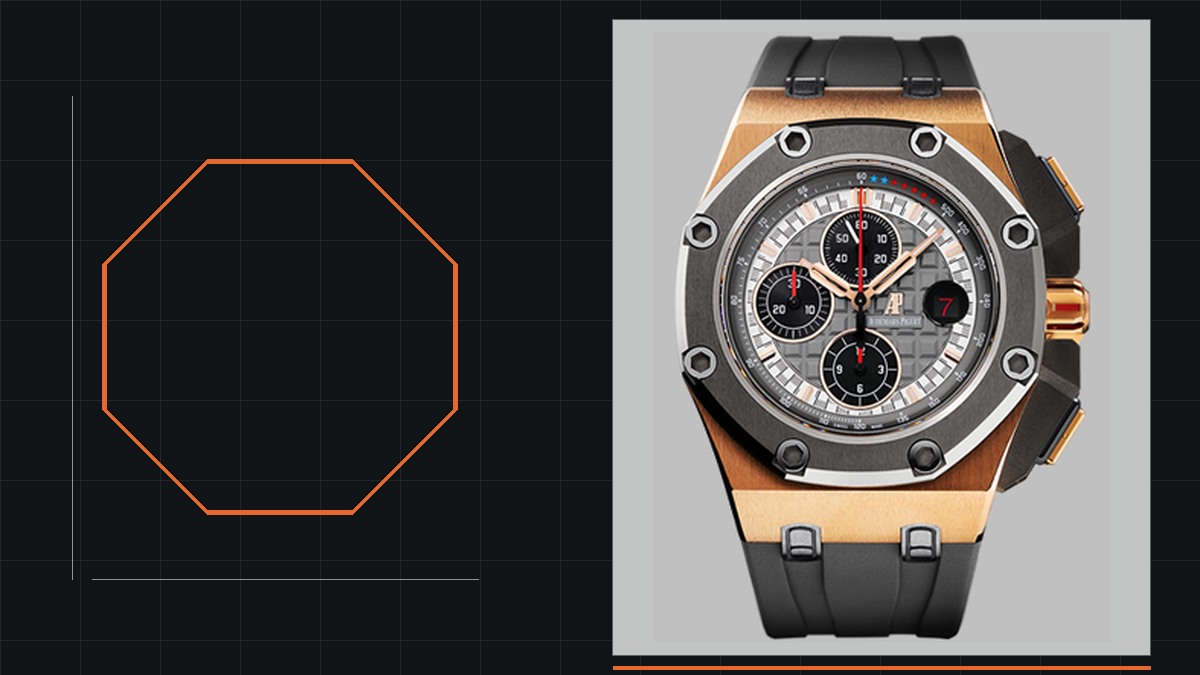
The Royal Oak Offshore deliberately amplifies the Royal Oak language. Older 44 mm generations used very different case and chronograph solutions from the modern 43 mm 26420 family. The current 26420 Offshore uses the integrated flyback Calibre 4401, a 43 mm case, 14.4 mm thickness and 100 m water-resistance specification on the genuine watch. Earlier 44 mm examples associated with Calibre 3126/3840 used a modular chronograph construction and different pusher geometry.
That history is important when judging a replica. A watch styled after an older 44 mm Offshore should not be evaluated as if it were a modern 26420. The visible clues—subdial position, date location, crown guards, rectangular or round pusher forms, caseback depth and strap interface—belong to a particular generation.
Movement claims only become useful when they explain the dial
AP replica listings often lead with movement language: Swiss, Japanese, clone, decorated automatic, 28,800 vph. The important question is what that movement architecture forces the watch to look and behave like. A central-seconds Royal Oak is easier to package around a generic automatic movement than a flyback chronograph or perpetual calendar. Chronograph subdial spacing and total case thickness are especially revealing.
A decorated rotor is not proof that the movement beneath it matches the genuine AP calibre. Verify the function set, beat rate when disclosed, chronograph engagement, date-change behavior and serviceability. If a listing claims a Calibre 4401-style construction, the visible layout should be consistent with that claim.
A repeatable QC routine beats factory mythology
Factory names and grades change quickly. A repeatable inspection routine ages better. Compare the actual watch against the exact AP reference or generation it is meant to resemble, and ask for photographs that show the front, case profile, caseback, clasp and bracelet or strap junction. For chronographs, request a short video showing start, stop and reset. For complicated displays, ask to see the calendar advance.
| Area | What to inspect | Why it matters |
|---|---|---|
| Case | Thickness, bezel geometry, brushing direction | AP cases rely on sharp transitions between planes. |
| Dial | Tapisserie scale, logo position, markers | Pattern size changes by collection and generation. |
| Bracelet / strap | First-link fit, taper, clasp | A gap at the case destroys the integrated look. |
| Movement | Function set, subdial layout, date behavior | Architecture determines visible proportions. |
| Water claims | Individual pressure-test evidence | Genuine AP ratings do not transfer to a replica. |
The heritage pages still matter
This site has carried older AP material for many years: the Tradition perpetual calendar, Jules Audemars moon-phase calendar, Millenary Quincy Jones and several motorsport Offshores. Those pages are worth preserving because they describe real historical design directions that no longer dominate the current catalogue. They have been rewritten here as heritage files rather than left as thin machine-translated posts.
That distinction is useful for searchers as well as collectors. A discontinued special edition should be treated as a historical configuration with its own geometry and dial details—not as a generic current AP model.
Why the Royal Oak family rewards model-specific research
AP has changed case sizes, movement families, dial patterns and bracelet details repeatedly without abandoning the basic Royal Oak silhouette. That continuity creates a trap: two watches can both look “Royal Oak” while belonging to different technical generations. A replica that blends a modern 15510 dial with an older 15400-style case, or a 16202-style Petite Tapisserie pattern with 41 mm proportions, may still look attractive but it is not a coherent copy of a single reference.
This is why the site now treats each major generation as an engineering file. The question is not whether a watch looks expensive in isolation; it is whether the case, dial, movement, bracelet and complication layout all point to the same target.
AP finishing is directional, not decorative
Brushing on a Royal Oak is not a generic satin surface. The direction of the grain follows the geometry of the bezel, case and bracelet, while polished bevels create narrow lines of contrast. A replica can use decent steel and still look wrong if the finishing direction is inconsistent. Strong side light is useful because it makes grain changes and polished edges visible without relying on macro magnification.
What a seller photo can prove—and what it cannot
Clear photographs can reveal alignment, geometry, printing, hand length, bezel screw fit and many finishing defects. They cannot prove stainless-steel grade, ceramic composition, precious-metal content, sapphire chemistry or water resistance. Those claims require documentation or testing. Treating visual QC and material verification as separate tasks prevents a common mistake: assuming that a watch that looks good must also have every claimed specification.
Source notes
Technical specifications in this file are cross-checked against manufacturer material where available.