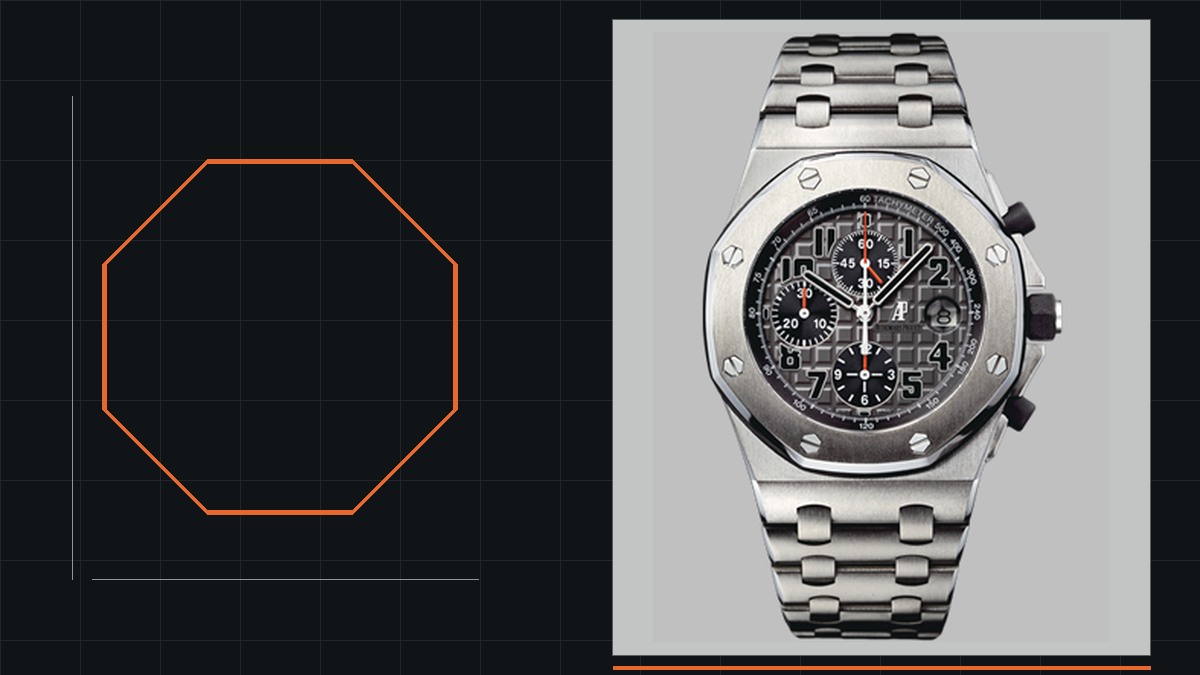
The older 44 mm Offshore deserves its own baseline
The source article was built around the era of large 44 mm Offshores with ceramic bezels, rectangular pushers and the Calibre 3126/3840 combination. That construction used a timekeeping base calibre with a chronograph module above it. The resulting movement stack influenced subdial layout, date position and total case height.
This historical baseline should not be erased. It explains why many older Offshore replicas look and wear differently from current models, and why a copy styled after that era should be judged against the older architecture rather than the newest catalogue.
The modern 26420 resets the dimensions
The current Royal Oak Offshore 26420 family uses a 43 mm case and integrated Calibre 4401. On the genuine steel-and-ceramic 26420SO, AP specifies 14.4 mm thickness and 100 m water resistance. The dial retains the bold Méga Tapisserie language, but the chronograph architecture and case details are different.
Méga Tapisserie is big, but it is not crude
The Offshore pattern is intentionally larger than Royal Oak Petite or Grande Tapisserie, yet the squares should remain crisp and evenly defined around the subdials. On replicas, soft moulded texture and inconsistent depth can make the dial look toy-like. Check the transition from the pattern into the counters and the alignment of applied markers.
Case hardware tells you the generation
Older Offshore generations used different pusher forms and guards from the modern 26420. Check the exact reference photographs before treating “rectangular pushers” or “ceramic pushers” as universal Offshore traits. On every generation, the octagonal bezel must sit evenly, the eight screw positions should be consistent, and brushing should follow clean directional planes.
Movement architecture is visible without opening the watch
A modular chronograph and an integrated flyback chronograph package the watch differently. You can often see the consequences in case thickness, date position, subdial spacing and crown-to-pusher relationships. This is why the label “Swiss movement” is much less useful than identifying what architecture is actually inside.
QC the Offshore as a system
- Identify whether the target is an older 44 mm generation or modern 43 mm 26420.
- Check pusher and crown-guard shapes against the exact generation.
- Compare Méga Tapisserie scale and counter spacing.
- Verify chronograph start/stop/reset and flyback if claimed.
- Inspect strap-end integration or bracelet first-link geometry.
- Request an individual pressure test before relying on any water-resistance claim.
Do not mix 42, 43 and 44 mm Offshore cues
The Offshore name covers decades of evolution. Historical 42 mm references, later 44 mm chronographs and the current 43 mm 26420 family can share Méga Tapisserie and an octagonal bezel while differing in crown guards, pushers, strap systems and case shape. A replica catalogue that labels every large AP chronograph “44 mm Offshore” is already signaling weak reference control.
Rubber straps reveal case accuracy
A bracelet can sometimes hide small errors at the case junction. A fitted rubber strap cannot. If the end contour does not match the case, gaps or compression appear around the lugs. Check both sides of the watch because moulding inconsistencies can produce a good fit on one side and a visible gap on the other.
Ceramic claims deserve separate scrutiny
Dark bezels and pushers may be described as ceramic even when they use coated metal or another composite. Visual inspection can assess surface uniformity and edge quality, but not composition. If material identity matters, ask what evidence supports the claim. A watch can still be evaluated for geometry and finishing even when the material cannot be confirmed.
Case weight distribution affects comfort
Offshore cases are large, and a heavy case on a soft rubber strap can rotate on the wrist if the strap shape and buckle position are poor. Ask for wrist photographs when possible. A replica can look dimensionally convincing yet feel top-heavy because the movement, caseback and strap geometry distribute mass differently.
Pusher resistance should be consistent
Chronograph pushers should not require dramatically different force. A sticky start pusher or soft reset can indicate movement adjustment issues. Videos with audio can sometimes reveal rough or inconsistent engagement that a visual clip alone misses.
Decision note: choose the generation before the color
Offshore buyers often start with dial color, strap color or metal tone. The more important first choice is generation. A 44 mm modular-era Offshore and a 43 mm 26420 have different engineering cues. Once the generation is correct, color becomes a configuration decision. Reversing that order makes it easy to accept a hybrid build that looks attractive but has no coherent reference target.
Source notes
Technical specifications in this file are cross-checked against manufacturer material where available.