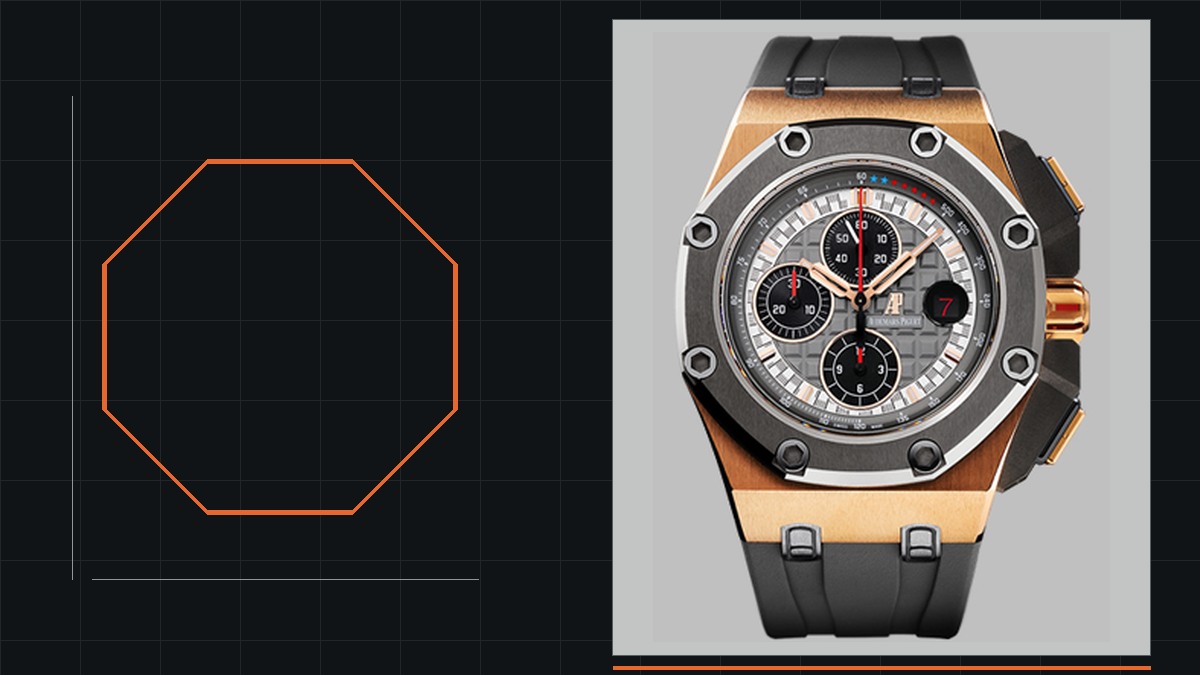
The limited-edition structure is part of the identity
The original article preserved useful production details: 1,000 titanium pieces, 500 pink-gold pieces and 100 platinum pieces, each in a 44 mm Royal Oak Offshore case. The references and metal combinations matter because the dial, strap color and case hardware should agree with the edition a replica claims to reproduce.
A seller photo that mixes a titanium-style dial with pink-gold case details should be treated as a configuration error, not an artistic variation.
The seven stars are not decoration without meaning
The tachymeter scale carries seven championship stars—two blue and five red—referencing Schumacher’s seven Formula One drivers’ titles. The minute track evokes a chequered-flag pattern, while the chronograph counters and red timing hands strengthen the motorsport theme. Those are unusually specific visual details and therefore useful QC anchors.
Check star count, color order, printing sharpness, counter color and hand length. On a low-resolution replica dial, these details often merge into a generic racing motif.
Cermet, screws and pusher guards create the hardware signature
The special edition used a cermet bezel and distinctive case hardware. Replicas frequently substitute ordinary coated metal or ceramic-like finishes. Material claims cannot be proven from a photograph alone, but surface uniformity, scratch resistance claims and edge finishing can still be questioned.
The strap attachment and pusher guards should look engineered rather than simply bolted onto a generic Offshore case. Compare the crown, pusher colors and guard geometry with the exact metal edition.
Movement should support the chronograph layout
The historical watch belongs to the earlier Offshore chronograph era. A replica may use a different mechanical or quartz chronograph. The important thing is that the function architecture matches the visible layout and that the seller does not use a decorated rotor or caseback as a substitute for explaining the actual movement.
A focused Schumacher QC sequence
- Confirm titanium, pink-gold or platinum-style configuration.
- Count and inspect all seven championship stars.
- Check counter color and chronograph hand color for the claimed edition.
- Inspect cermet-style bezel finish and screw alignment.
- Run the chronograph through start, stop and reset.
- Check strap-end fit and pusher-guard symmetry.
Limited-edition replicas are vulnerable to “parts-bin” combinations
Special editions are produced in lower replica volumes than generic black or blue Offshores. That makes mixed components more likely. A case may resemble one edition while the dial or strap comes from another. The safest approach is to compare the full configuration—case metal style, bezel, dial, counters, strap color, crown and pusher accents—against one reference at a time.
The motorsport graphics should remain legible at macro scale
The Schumacher dial contains more narrative detail than a standard Offshore. Under magnification, the stars should be discrete, the checkered motif should remain structured and the tachymeter printing should not merge into the outer track. Poor replicas often rely on the overall color scheme while losing the fine graphic relationships.
Edition numbering is not authentication
A numbered caseback can make a replica look more complete, but the presence of “001/1000” or another number is not evidence of provenance. Treat engraving quality as a finishing check only. Movement architecture, dial configuration and case geometry remain more useful quality signals.
Metal-edition differences should extend beyond case color
Titanium, pink-gold and platinum versions did not exist merely as color swaps. Dial and strap accents differed as well. A replica that changes only the case tone while keeping every other component identical may be a simplified hybrid. Compare the claimed edition as a complete parts set.
Check tachymeter spacing around the full circumference
The outer racing scale is easy to distort when a dial is resized for a different movement or case. Inspect whether numerals crowd the bezel at one side or whether the track remains evenly spaced. Circular scales are sensitive to even small print-position errors.
Decision note: the dial deserves more attention than the caseback number
The seven-star championship theme is visible every time the watch is worn, while edition numbering is usually hidden. Prioritize star placement, counter colors, racing-scale printing and bezel hardware before worrying about whether the caseback carries a convincing limited number. Those front-facing details define the edition far more strongly.
Source notes
Technical specifications in this file are cross-checked against manufacturer material where available.