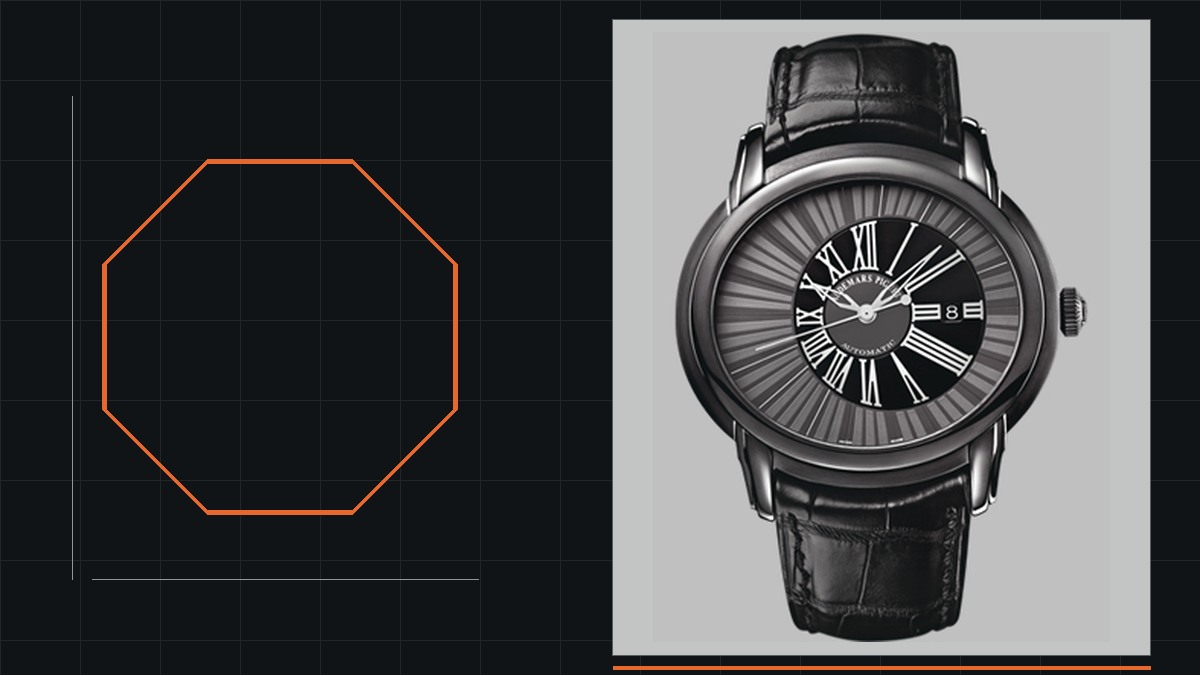
Do not force Royal Oak expectations onto a Millenary
The original Quincy Jones page described a broad black Millenary case and an unconventional dial. Although the English was rough, it captured the main point: this collection uses an elongated oval form and intentionally displaced visual elements. A replica that simply stretches a round watch case misses the architecture.
Asymmetry still requires precision
Off-center hands, Roman numerals and decorative patterns must look intentional. Check how the time display relates to the case opening and date aperture. If the dial furniture appears randomly shifted rather than designed around the oval, the watch loses the Millenary character.
The case should be slim enough to preserve elegance
A large footprint does not mean the watch should be thick. Side views reveal whether a generic movement has forced a deep caseback. Compare lug curvature and the way the case meets the strap.
A black strap should finish the composition
The historical Quincy Jones theme used a dark, formal presentation. Inspect strap width, stitching, buckle or clasp finish and the gap at the case. Cheap straps can undermine an otherwise reasonable case and dial.
QC the silhouette first
- Confirm the oval case proportions before judging dial detail.
- Check off-center display alignment.
- Inspect Roman numerals and printed pattern under magnification.
- Check date-window position and function.
- Inspect strap/case fit and clasp finishing.
Oval cases complicate movement placement
Most automatic movements are round. Fitting one into an oval case leaves unused space and creates choices about stem position, dial feet and date location. Those packaging decisions can affect the visible alignment of the off-center dial. A replica that uses a generic movement may therefore show disproportionate empty zones or an awkward crown position.
Black coatings make scratches a practical concern
The historical all-black aesthetic can be visually strong, but coated surfaces reveal wear differently from polished steel. Inspect edges, buckle contact points and caseback perimeter for early chips. If the seller claims a particular coating process, ask whether refinishing is possible.
Celebrity association is not a technical quality signal
The Quincy Jones connection identifies the edition but does not say anything about the quality of a replica. Use the name to locate the correct configuration, then judge case proportions, dial architecture, movement function and finishing like any other watch.
Off-center displays make hand-stack position obvious
Because the time display is shifted away from the geometric center of the case, the relationship between hands, printed scales and surrounding empty space is critical. A movement with the wrong pinion position can force the entire dial layout to move, changing the design rather than merely creating a small alignment error.
The date aperture should feel integrated, not added later
A generic movement can place the date wheel at a radius that does not suit the Millenary dial. Check whether the window has sensible proportions and whether the date numerals sit at a natural depth. Thick overlays can make the date appear recessed like a tunnel.
Edition-specific black styling benefits from texture contrast
An all-black watch needs contrast between polished, brushed, lacquered and matte surfaces so it does not become visually flat. Even when materials differ from the genuine watch, better replicas preserve that hierarchy of textures. Inspect the case edge, dial surface, strap and buckle under changing light.
Decision note: fit matters because the case is unusually wide
The Millenary silhouette covers more wrist width than a conventional round watch of similar nominal size. Buyers with smaller wrists should ask for lug-to-lug and strap measurements rather than relying only on case width. A replica that alters lug position or strap angle can wear substantially larger than the historical design, even if the dial itself looks close.
Source notes
Technical specifications in this file are cross-checked against manufacturer material where available.