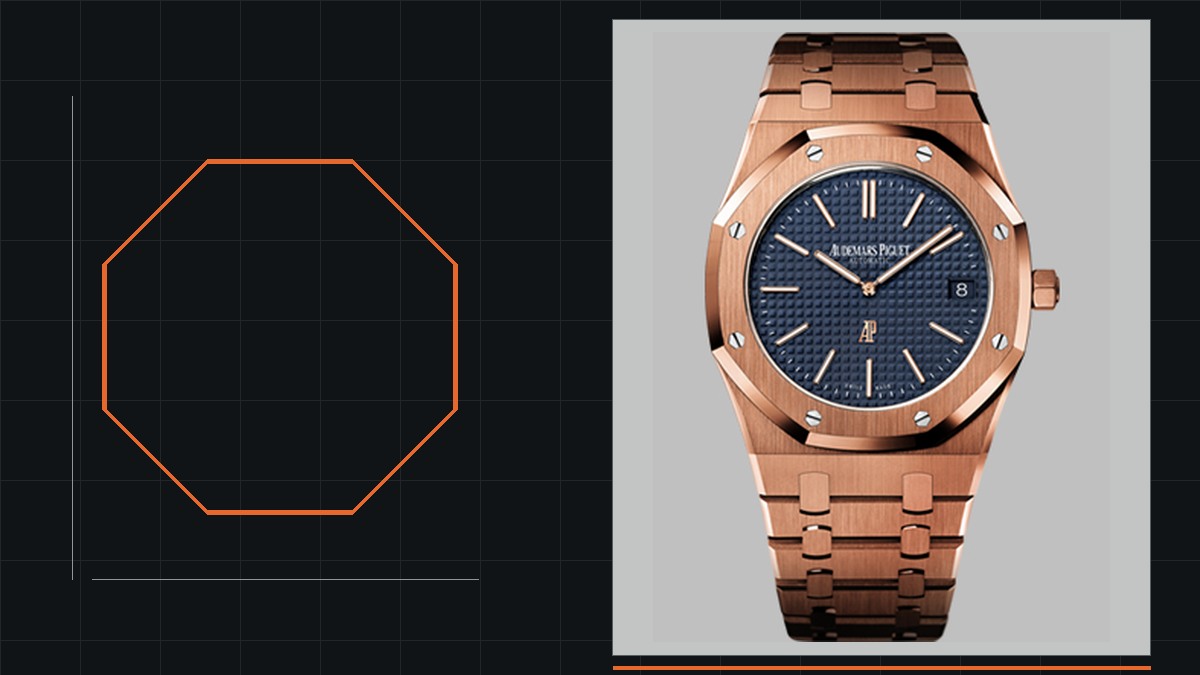
The profile tells you more than the diameter
The current 15510 family established the modern 41 mm Royal Oak Selfwinding proportion. On the genuine steel watch, the case is 10.5 mm thick and water resistant to 50 m. The number “41 mm” is only the beginning. What gives the watch its stance is the relationship between the octagonal bezel, case middle, lugs, first bracelet links and the narrow polished bevels that run through the construction.
A replica can hit the nominal diameter and still look heavy because the mid-case is too tall or the bezel is too thick. Side photographs are therefore more valuable than another front-on glamour shot. Compare the crown position, bezel-to-midcase ratio and the height at which the first bracelet links leave the case.
Grande Tapisserie should have scale, not just texture
The 15510 uses a Grande Tapisserie dial. On a convincing copy, the pattern needs the correct scale relative to the hour markers and date aperture. Oversized squares make the dial look coarse; an overly fine pattern starts to resemble a different Royal Oak generation. The AP signature, applied markers and minute track must all sit comfortably inside that grid.
Pay special attention to the date window at 3 o’clock. The window should not appear squeezed between the dial pattern and marker. Misaligned date discs, weak printing and a window placed too close to the center are common signs that the movement and dial were not designed as one package.
The bracelet is part of the case
The integrated bracelet is not an accessory. Its first links complete the architecture of the case and determine how the watch drapes on the wrist. Check the width and angle of the first link, the progression of brushed surfaces, polished bevels and the taper toward the clasp.
A replica with stiff articulation often looks acceptable when laid flat but wears differently. Ask for a photo of the bracelet hanging naturally from the case. Large gaps, abrupt link steps and inconsistent brushing are easier to see in that position.
Calibre 4302 sets a functional baseline
The genuine 15510 uses AP Calibre 4302, a 4 Hz automatic movement with central seconds, date and roughly 70 hours of power reserve. Replica versions may use entirely different architectures. A movement does not need to imitate 4302 internally to be practical, but sellers should describe it honestly.
When a listing claims a “4302 clone,” ask what is actually cloned: dimensions, bridge layout, winding architecture, function position, or only rotor decoration. The date should advance cleanly, the seconds hand should run consistently, and the movement should be serviceable by someone who can obtain parts.
QC: look for agreement between all the parts
- Compare the 41 mm case proportions from front and side.
- Check screw-head depth and spacing around all eight bezel positions.
- Inspect the Grande Tapisserie scale around the AP logo and date aperture.
- Look for even hand and marker lume application.
- Check the first bracelet link for gaps and incorrect angle.
- Verify that the date changes cleanly and the crown operates without grinding.
The 15510 date window is a packaging clue
The date aperture may look like a minor detail, but it reveals how well the movement, dial and case were designed around one another. If the underlying movement places the date wheel at a different radius, manufacturers must compensate with a larger window, an offset print position or a custom date overlay. Those fixes can introduce uneven font centering, excessive depth beneath the dial or a date that sits too close to the marker at three o’clock.
Ask for several date values rather than one photograph. A date wheel can appear centered on a narrow “1” and look obviously shifted on a wide “28.” Consistency across the whole wheel is a better sign of execution.
Bracelet taper changes the perceived size of the watch
The 41 mm Royal Oak looks broad at the case but becomes more elegant as the bracelet narrows. If the taper is too weak, the watch feels blocky; if the first links are too narrow, the case appears oversized. Examine the bracelet as a silhouette, not only link finishing. The clasp should also sit within that taper instead of creating a sudden wide block at the underside of the wrist.
Rotor decoration is easy; movement height is not
Decorated bridges and rotors are inexpensive ways to imitate a display-back view. Matching the vertical position of the stem, hand stack and date wheel is more demanding because those dimensions determine the case. When comparing a claimed 4302 clone, side profile and crown height often provide more useful evidence than a rotor engraving.
Decision note: a balanced build beats one headline feature
A buyer may be tempted to choose the version with the most elaborate movement or the heaviest bracelet. For the 15510, overall proportional balance usually matters more. A correctly shaped 41 mm case, clean Grande Tapisserie dial, centered date and articulate bracelet create the Royal Oak impression together. If one of those fundamentals is wrong, movement decoration rarely compensates.
Source notes
Technical specifications in this file are cross-checked against manufacturer material where available.