Calibre 4302: the modern 41 mm Royal Oak baseline
The genuine 15510 uses Calibre 4302, a 32 mm automatic movement running at 4 Hz with about 70 hours of power reserve. Its function set is straightforward: hours, minutes, central seconds and date. That simplicity means a practical replica can use another reliable automatic movement without creating obvious chronograph-layout problems, provided case thickness and date position remain correct.
Calibre 4401: chronograph architecture becomes visible
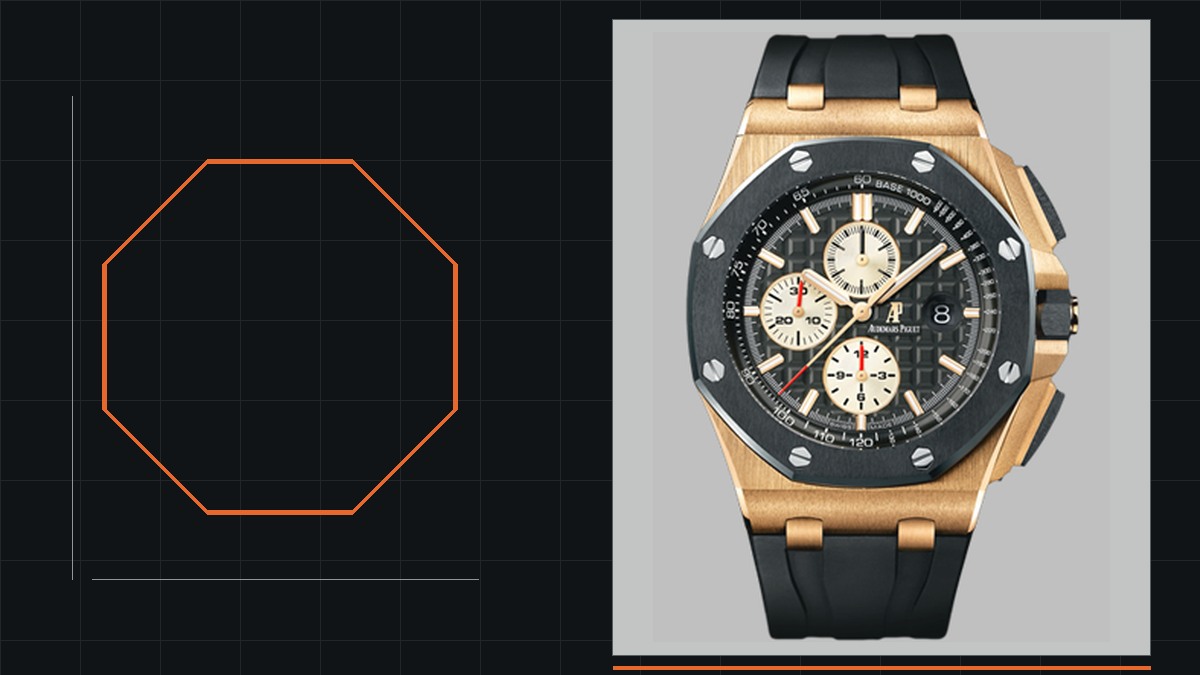
Calibre 4401 is AP’s integrated selfwinding flyback chronograph. It runs at 28,800 vph, carries about 70 hours of reserve and is used across modern Royal Oak Chronograph, Royal Oak Offshore and Code 11.59 chronograph references. Because the chronograph is integrated, its architecture sets subdial positions, pusher feel and movement height.
A replica seller using the phrase “4401 clone” should be able to explain whether the movement duplicates function layout, dimensions and bridge architecture or only decorates a different chronograph to resemble AP through a display back.
Calibre 7121: thinness is the requirement
The 16202 Jumbo uses Calibre 7121. The challenge for a replica is not simply making a rotor look similar; the movement package needs to allow the thin 39 mm case silhouette. A generic thick movement can force compromises visible at the caseback and bracelet junction.
3126/3840: understand the modular Offshore era
Older Offshore chronographs frequently referenced Calibre 3126/3840, a modular arrangement with a chronograph module above a timekeeping base. That stack helps explain historical case thickness and dial geometry. It should not be confused with modern 4401 construction.
Replica labels: Swiss, Japanese and clone
| Label | What it may describe | What to verify |
|---|---|---|
| Swiss movement | Origin or marketing claim | Exact calibre, function set, serviceability |
| Japanese movement | Often Miyota or Seiko-family automatic | Exact reference, date position, beat rate |
| Clone calibre | Visual or architectural imitation | Which dimensions/functions are actually cloned |
| Decorated movement | Cosmetic bridges/rotor | Underlying base movement and parts availability |
A Japanese or Swiss base movement can be a sensible reliability choice even when it is not an AP clone. The SEO-era assumption that nationality alone equals quality is too crude. Buyers should prioritize correct dimensions, honest function description and service access.
Serviceability is part of quality
A highly decorated clone can be less practical than a simpler established movement if replacement parts are unavailable. Ask who can service the calibre, whether key chronograph parts are obtainable and whether the movement can be replaced without changing hand height or dial position.
Beat rate is a clue, not a verdict
A 28,800 vph movement can visually approximate the seconds-hand cadence of many modern AP calibres, but beat rate alone says little about architecture, durability or decoration. A lower-frequency movement can still be robust. Use frequency as one data point alongside hand stack, date position and serviceability.
Chronograph modules create predictable compromises
When a chronograph module is stacked on a base movement, the crown and pushers may sit on different vertical levels and the case must accommodate the extra height. That can be historically correct for older Offshores but incorrect for a modern integrated-chronograph target. Understanding the target generation prevents mislabeling an architectural difference as a defect.
Movement photography should show more than the rotor
Ask for images with the rotor moved away from the bridges. A rotor can obscure the very components needed to identify a base calibre. Look for balance position, bridge shape, regulator design and visible chronograph levers where relevant. These details are more informative than engraved text on the oscillating weight.
Replacement strategy matters for ownership
Some replica movements are effectively disposable: if they fail, the realistic repair is a full movement replacement. That can be acceptable if replacements are standard and inexpensive. It becomes a problem when the movement is proprietary, difficult to source and tied to a custom dial or hand stack. Buyers should understand this before paying a premium for a highly decorated clone.
Hand height ties movement choice to dial construction
Different movements use different cannon-pinion and hour-wheel heights. When a dial and hands are adapted to a movement, manufacturers may use custom pinions or spacers. Poor solutions create hands that sit too high, collide with markers or leave an oversized gap above the dial. This can be inspected without opening the case.
Rate data should be interpreted realistically
A timegrapher screenshot is useful, but one position at full wind does not prove long-term accuracy. Ask for rate, amplitude and beat error if available, then treat them as a snapshot. Chronograph engagement, power reserve and positional variation also affect real-world performance.
Choose movement architecture according to the watch, not a universal hierarchy
There is no single “best” AP replica movement for every model. A Jumbo prioritizes thinness, a 15510 needs stable time/date geometry, an Offshore chronograph needs correct counter placement and a perpetual calendar needs reliable multi-display operation. Movement quality therefore has to be judged in context. The architecture that best serves one model may be a poor choice for another.
Decoration should be the final layer of evaluation
Once dimensions, function and serviceability are acceptable, bridge shape, rotor engraving and surface finishing can improve visual similarity through a display back. Reversing that order encourages buyers to pay for decoration before confirming whether the movement actually supports the watch it is meant to imitate.
Source notes
Technical specifications in this file are cross-checked against manufacturer material where available.